If the universe is so vast, where is everyone? Explore the Fermi Paradox through interactive simulations. Adjust Drake equation parameters, watch civilizations rise and fall, and see if first contact is possible.
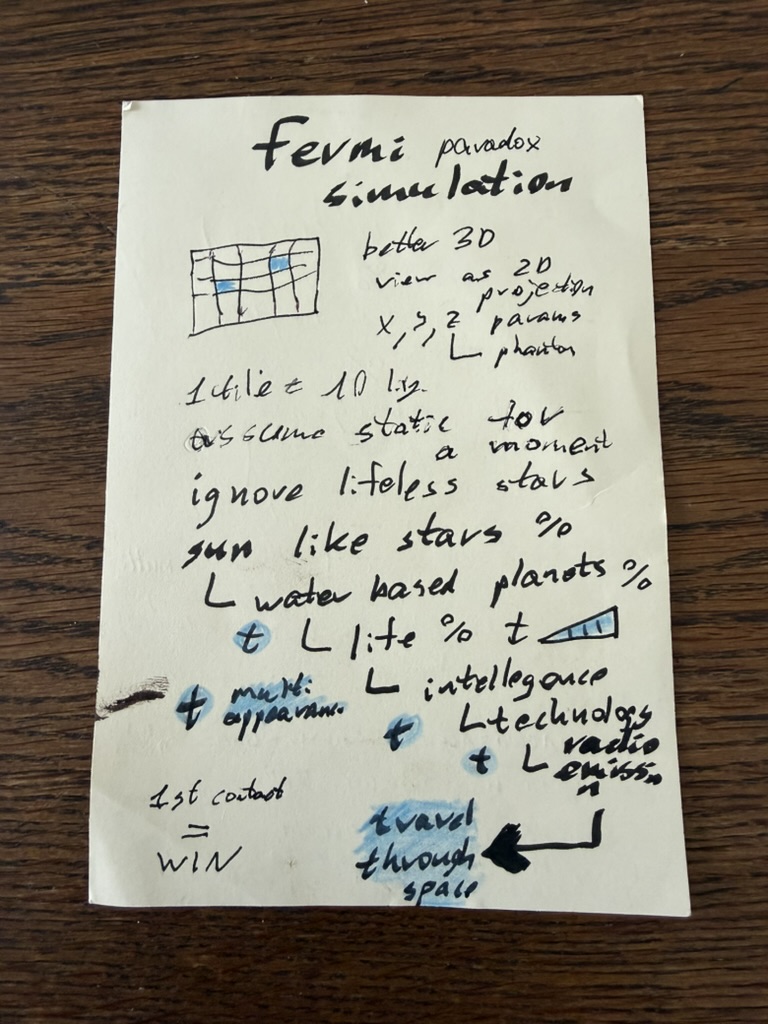
Top-down view of the galaxy as a grid. Each tile is 10 light-years. Watch life emerge, civilizations develop, and radio signals propagate as expanding circles.
2Rotating 3D view of the galaxy with stars as particles. Fly through space, see radio bubbles as glowing spheres, and witness first contact in three dimensions.
5Full parameter control with real-time charts. Run Monte Carlo simulations. Explore how each Drake equation variable affects the probability of contact.
7The Drake equation as a cascading waterfall. See 20,000 stars filter down through each probability gate until almost nothing remains.
A 2D heatmap revealing sharp phase transitions. Small changes in parameters flip the galaxy from silent to teeming with life.
15Where does the Great Filter sit? Drag sliders to hypothesize which evolutionary step kills most civilizations and see the consequences in real time.
Explore the 3D galaxy model layer by layer. Switch between XY, XZ, and YZ planes and slide through depth to see life emerge in three dimensions.
17The full 3D simulation rendered in Three.js. Stars fill a cubic volume with real 3D positions. Radio bubbles are true spheres. Rotate and fly through the volume.
A deep dive into the simulation's key findings: the N²×L scaling law, five independent filters that overdetermine the silence, temporal fireflies, and why the galaxy is likely alive but invisible.
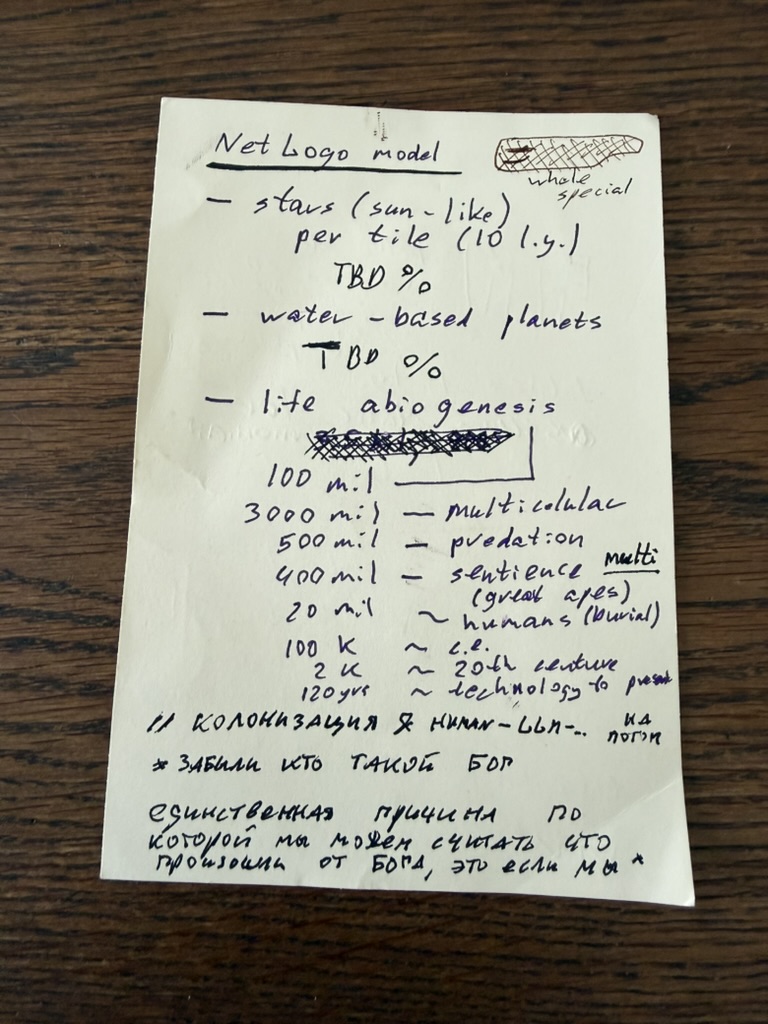
The science behind the simulation. Key findings from 75,000 Monte Carlo universes, the master equation, and the five profound ideas that explain the Great Silence.
•Modern estimates for each parameter. From Kepler-solved certainties (fp = 1.0) to mysteries spanning 15 orders of magnitude (fl, L).
•Nine stages from abiogenesis to radio. Two critical bottlenecks — eukaryogenesis and intelligence-to-technology — that may filter out most civilizations.
•Why 75,000 simulated universes produced almost no contact. The parameter hierarchy, sharp phase transitions, and five independent filters.
•100+ peer-reviewed papers supporting every simulation constant. Organized by topic from stellar census to SETI detection, with links to arXiv and journals.